RSS

Raw Honey and Bee Pollen from the Bald Hills for sale

October 19th, 2011 | No Comments

Bee Forever Apiary Honey lLbel

Bee Forever Apiary Honey Label


Our Wildflower Honey
Bee Forever Apiary operates in the Bald Hill area near Yelm, WA. This area is very rural and unpolluted.
Enjoy our pure and unprocessed raw wildflower honey. No heating is applied during the extraction and bottling process and therefore, all the valuable ingredients like enzymes remain intact. The water content is below 17%, so the honey can be stored for a long period of time in a cool, dry and dark place. Eventually the honey will crystallize into a fine creamy texture that maintains its full quality. If you prefer the honey to be liquid simply heat the jar in a water bath with max. temperature of 110F.
1 quart glass jar contains 3 lbs of honey. Price $15.00

Order through email at bee4ever@fairpoint.net or call (360)894-6038

More general information about honey see this page: Honey Info

Bee Forever Apiary Bee Pollen Label

Bee Forever Apiary Bee Pollen Label


Our Air-dried Pollen
Bee Pollen from the Bald Hills area are delicious. Rich in proteins, essential amino acids, vitamines, and trace minerals, bee pollen is a very valuable food supplement. Every flower has its distinct pollen color and characteristics. The more variety in colors the more valuable the pollen is. Keep the pollen in the freezer or the fridge if it is not consumed rapidly. For longer term storage we now offer our dried pollen vacuum packed.
1 ziploc bag contains 1 lb of bee pollen. Price $19.00
vacuum packed: 1 lb of bee pollen. Price $20.00

Order through email at bee4ever@fairpoint.net or call (360)894-6038

For more information about bee pollen see this page:Pollen Info


More Learnings from Warre Beekeeping

March 10th, 2011 | No Comments

6) The mosquito screen is not suitable for the quilt. Ants, earwigs and the bees chewed throughg it very quickly. A fine hardware cloth is doing a better job.
7) Mice or some othe criters totally dismantled the glassfiber insulation pad in the roof. The only thing left was the paper. Therefore, all openings in the roof were secured with a piece of hardware cloth after renewing the pad.
8.) In fall/winter the shavings became pretty wet after a while. The board from the roof that sits on top of the quilt was also very wet. The roof and the shavings needed to be exchanged twice so far.
9) It is advisable to have an extra burlap cover before putting on the quilt. The quilt can be removed much easier.
10) My bees were very reluctant to move downwards into the second box. Only after providing some pieces of wax combs they started bulding and filling the second box. The same thing happened with the third box. However, some of the comb pieces fell off and it was getting late in summer so the third box remained basically untouched.


My First Learnings with the Warre Hive

July 5th, 2010 | No Comments

1) Before introducing a package or a swarm into one box it is beneficial to have marked the position of the top bars if they are not nailed in place. With all the bees crawling around and mainly upwards it was not easy to put the top bars in the appropriate position. I chose not to nail them in order to make room for the bees to drop on the bottom board.
2) When a swarm or a package is introduced in two boxes I will nail the top bars of the lower (2nd) box in future. The dropping bees totally misplaced all of the topbars of the lower box.
3) The main amount of moisture of the hive does not originate from the sugar syrup. Condensation water was formed above the quilt and was dropping back on the quilt whether the hive was fed or not. I saw straw get moldy in the quilt after 14 days only. However, no mold was found in a quilt filled with (fir)wood shavings although the top half inch was wet.
4) The most effective measure to minimize condensation water is to insulate the board that sits on the quilt. This board is part of the roof so the insulation goes between this board and the rooof boards. Since I put the insulation (I used a glass fiber patch with paper towards the quilt) the shavings are considarable less moist if moist at all.
5) My standard hive stand are two H-cement blocks (8×8x16″). Willie had the glorious idea to set the blocks so far appart that the hive sits on the inside edges of the blocks only. That leaves a big space underneath the hive to introduce a bigger mirror for observation.


My Warre finally got started!

June 18th, 2010 | No Comments

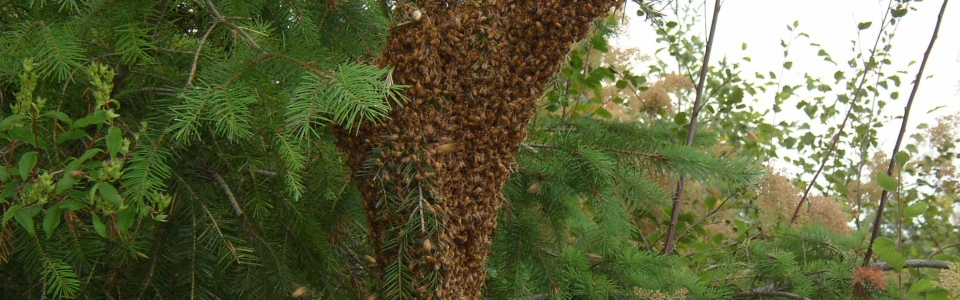
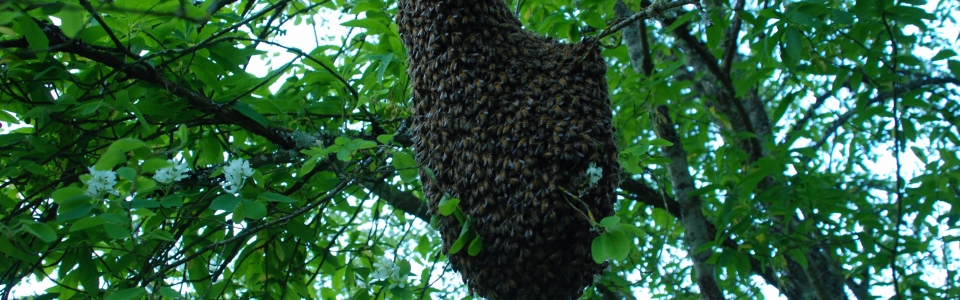
Last week it finally happened. I caught my first swarm from one of my hives. It was extremely easy: the bees just crawled up the wall and clustered underneath the roof. I collected them in my swarm box and introduced them into the Warre hive with two boxes.
Swarms are notorious for fast build up so lets see how long it takes them to fill the first two boxes… At a clients apiary I have seen that a swarm had built as much combs in two week what the package bees took seven weeks to build.


The adventure of Warre Beekeeping in the Pacific Northwest

June 4th, 2010 | No Comments

My own Warre hive is still empty, waiting for a swarm to inhabit it. But I have started 9 Warre hives with packages between April 25th and 28th 2010 for several clients of mine.
I would love to share my observations and experiences with all of you guys out there operating one or more Warre hives in the Pacific Northwest.
To check out all details on our version of a Warre hive click Warre Beekeeping at the botom of the page.


This Website

May 4th, 2010 | No Comments

To get an overview click about or scroll down to the bottom of this page.


Special Class about Natural Beekeeping coming up

April 4th, 2010 | No Comments

A special class is scheduled for Thursday April 8th 2010. For details click classes.


Straw Skep capable of being dismantled: This is how I got started in Beekeeping

March 8th, 2009 | No Comments

A modern dismantable skepThis is the way I got started in beekeeping 10 years ago. In a 2 day seminar in Switzerland we built this skep out of Rye straw and prefabricated wooden parts. It is totally capable of being dismantled and every frame can be inspected individually, as requested by law.

The pictures are showing a fully covered basket, a top view and a view from underneath without baskets. The frames are standing individually on the board that divides the skep and can be removed for inspection.

Meanwhile I live in the Great Pacific Northwest and I have changed to standard bee hives.Sideviewunderneath-view